
Will NFT Games have a place in 2026? Yes, but not for the same reasons that they were in early times of the industry.
Blockchain games were at one time a novelty, but now they are changing the world of games. This is a result of AI, and the more positive aspects of token economics, security, and a new idea of ownership in the digital era.
Artificial Intelligence is also helping to minimize cheating and scams, producing a more equitable gaming experience generally. It’s an industry that has evolved significantly in a relatively new period of time.
Rather than wondering if NFTs will last (they did), people are now wondering what impact these tokens could have on digital ownership and virtual economies.
How NFT Games Outlast the Competition?
The market corrections forced developers to care about the quality of their games. This creates a better environment with digital ownership playing a supporting role to the game, rather than dominating it.
Beyond the Viral Hype: Sustainable Game Flows
When the excitement died down and in the early days, more players were needed to support the price of tokens, many reward mechanisms failed.
As the GameFi space expands, it’s evolving, with a greater focus on sustainability, improved issuance, increased spending on upgrades and fees, more balanced rewards and increased usage of NFTs. Plus, games now have a longer-term progression that will keep players engaged.
This is one of the main differences between the older systems and newer ones where skills, contributions and strategy have the key focus of being rewarded, helping to avoid inflation and increasing in-game economies.
The Role of AI and Machine Learning
AI is one of today’s most prominent technologies in the game of tomorrow, the NFT gaming market.
Today AI systems can assist platforms in various ways:
- Help identify unusual behavior occurring on an account,
- Prevent multi-account abuse,
- Identify collusion patterns,
- Improve matchmaking,
- Personalize player experiences,
- Monitor economic stability.
As blockchain games become more competitive, AI algorithms are being increasingly developed to identify cheating in the game, and stop it from affecting the overall economy.
The transparent and AI-based nature is an excellent asset to building trust in decentralized games.
Regulatory Maturity
Every other government and corporation and all the agencies involved in this blockchain region are aging.
There is no longer any doubt about the NFTs today, in many jurisdictions there has been focus on the following now:
- Consumer protection,
- Digital asset taxation,
- AML compliance,
- KYC verification,
- Marketplace transparency.
Legislation differs depending on the region in the world; however, this increased clarity has driven to grow the business of professional game studios and tech vendors within the gaming community.
As an investor, these institutional approvals enhance the investors’ trust and increase security in the blockchain games sector.
How do NFT Games Make Money Today?
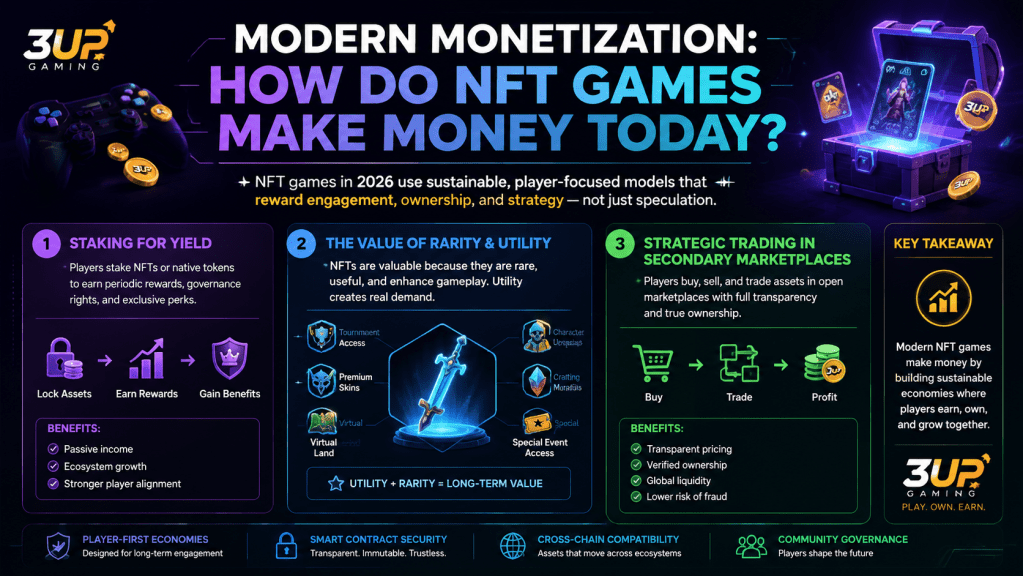
Revenue generation is not just a matter of taking money, it has grown beyond that.
Modern blockchain video games create diversified digital economies with a number of income streams that drive lengthy play.
Staking for Yield
Most ecosystems allow NFT owners to stake their NFTs or tokens. This will facilitate governance voting, can provide a stable reward, and can unlock unique content, early features and community rewards. The aim would be to have players aligned long term with the ecosystem, not in the short term for speculation.
The Rarity and Utility of the Value
Collectors are also affected by this change.
Now, I would say successful NFTs will include some in-game utility along with the rarity.
Examples include:
- Tournament passes
- Premium cosmetic collections
- Character upgrades
- Land ownership
- Crafting materials
- Special event access
This change is because digital assets will be of value mostly because they are useful, and not scarce.
Players have had meaning in digital property rights, since now there is a way to prove that they own it, other than relying exclusively on the centralized publishers.
Strategic Trading in Secondary Marketplaces
Secondary Non-Fungible Token markets give the users the full ownership history on the blockchain and the possibilities to trade, buy and sell assets. Verifying the real ownership, transparent pricing, avoiding fraud, global markets access and liquidity is a guarantee.
But where it really gets interesting is in the realm of cross-chain, where it becomes possible for the owner of an NFT to transfer it from one blockchain ecosystem to another.
The Play-to-Earn Evolution within Next Generation Digital Wealth
The term “play-to-earn” has also undergone changes. Nowadays, some sites either provide a healthy balance between virtual economies and rewarding the real interactions, instead of assuring you a constant revenue stream:
There has been a transition to play-and-own and play-and-build, skill-to-earn ecosystems.
Automated Rewards & Smart Contracts
With smart contracts handling most of the blockchain gaming finance, the transparency of rewards distribution, tournament payouts, marketplaces, creator royalties, on-chain proof of ownership, and much more are now automated.
This reduces the interaction, speeds up payment and ensures the same enforcement without interaction with human. The result is systems with more predictable outcomes and increased trust with less squandering along the way.
Gaming Guilds and Collective Strategy
There are still some reasons for some guilds.
A number of guilds are now getting involved with things like strategic coaching, asset lending, tournaments, community management, and diversification of portfolio, besides scholarships. This encourages newer players to come in and play without having to put up much capital upfront.
Guilds are very much becoming communities that are relying on themselves and ruling themselves.
Market Update: NFT Poker Booming.
The state of competitive poker
Blockchain technology has evolved over time with a good example being competitive poker.
NFT Poker websites are gradually merging:
- Transparent tournament rewards
- Verifiable ownership
- Blockchain settlement
- AI-assisted security
- Immutable game records
Existing speculative GameFi projects do not inherently have the learning incentive as poker has.
This ongoing balance management, blockchain self governance, will generate a sustainable player attractor experience, while lessening dependency on inflation of token distribution.
Blockchain poker is not just where the industry is heading, it also is one of the most successful examples of a skill-based digital economy.
Democratizing the Metaverse: 2026 Free-to-Play Innovation
A major breakthrough in the industry has been lowering the entry barrier.
So much for the old days where you would need hundreds of doses of capital to get into a blockchain game.
Removing Financial Barriers / Skill-to-Earn
Today′s blockchain play-to-earn games allows you to generate free accounts, test NFTs or even give optional upgrades, without having to buy it for your gamers before they jump into the game. This is a way to take spending down a notch by the game′s economics and have users saving over time.
Digital economy is shifting. We are now accessing the ‘skill to earn’ economy. Capital still matters but it is not the first thing which takes over the economy.
There will be a few ‘players’ earning throughout the season via (if you prefer) pass competitions, ranked within the game, craft, transfer market, season rewards, etc.
And strategy and consistency will be factors of the digital economy.
Easily see how both these systems flow value toward participation and skill and away from monetary input.
Successful Free-to-Play Blockchain Titles
There are a handful of blockchain games where the economic design feels much more balanced and offers more of the original cash play vs intrinsic ownership prospect. This free to play structure allows players to enter into the game without financial commitment, and then leverage digital assets.
The major differences are how Axie Infinity, Gods Unchained, and The Sandbox are really doing a different job by their own handling of play-to-earn, blockchain based card ownership and land economy creation by players.
In general these ecosystems are ducking the hype, FUD and becoming a greater game, governance, player base in the long term.
What enables today’s game economies?
Behind every successful blockchain game, there’s good economics.
Nearly all modern day ecosystems require a fully matured blockchain network before they are able to operate.
Major Blockchain Pillars
Ethereum leads the smart contract space. Ethereum 2.0 provides announcing scalability & energy consumption. Solana has high throughput & low fees to stay ahead of a growing gaming ecosystem for live apps.
Today the most innovative games are inter-operable across several layers of a blockchain, easily connected with the inter-ecosystem and non-custodial.
Utility Tokens and Stablecoins
Without native tokens and without stablecoins, there would just be no robust digital economy. Native tokens allow the voters to vote, to stake, to reward and to control the funds, enabling them to control what happens on the network.
Price volatility
A major problem with blockchain technology is that of price volatility. This makes buying and selling near impossible and causes prices of digital goods to be all over the place, however, Stablecoins combat that.
The more cooperation, the more reliable the stronger and more usable protocols we’d have.
Secure Transfers
The players get a far wider privilege to the game. Thanks to the blockchain system, digital money is more flexible than ever. They can be easily moved from wallet to exchange or wallet to NFT market place but always with the glass of ownership.
However, this is not the only thing about interoperability. Cross chain bridges can grow by enabling cross chain transfers that let you happily carry your assets to other blockchains.
For all transactions real ownership can be verified, greatly supporting a key benefit of blockchain gaming: digital ownership.
Conclusion: From Volatility to Sustainable NFT Economies
It’s not just another bubble, Transparent is an advanced, secure NFT gaming blockchain. At present, Transparent is a next-generation AI-enabled Security with tokenomic design that successfully fosters long-term user involvement, community and strategic gaming playing, on the contrary to brief short greed-oriented participation.
What does it mean to gamblers, game developers and investors? This is about engaging in digital economies that are connected rather than owning themselves, and it all stems from implementing technology, system and infrastructure for longevity and profitability.
It would appear inevitable that the jet propulsion of NFT gaming will accelerate the process of change for such in the transition from 2020 to 2026 and beyond. NFT gaming is not just a surge that will pail into insignificance, but instead a segment of the digital economy.
Key Takeaways
- Here is Digital ownership at last with open source smart contracts.
- Achieving longevity is based on tokenomics, the strategy, and the engagement of a community, not speculation.
- The converging ultra fusion of blockchain, AI and the competitive gaming aka: NFT Poker; which is underpinning the faster adoption and strength of digital economies.
FAQs: 2026 State of NFT Gaming
What are the plans for NFT games in 2026?
- No. The market became the way it is today. Entry is more stable than any previous speculative bubbles. Yes, we do have new players, but it’s a much more consistent fold when it comes to infrastructure, regulation, economics of their games.
What are the changes to NFT gaming since 2025?
- Today the AI goes beyond cheats catching, it is used for improving the detection of fraud, fair-play, matchmaking, economic monitoring and player support. The same is true for the majority of the competitive websites, which have embraced the AI for cheating suspicious behavior detection and also for boosting the security.
May I play out my NFT games on several platforms using the same assets?
- More and more, yes. One of the major focus points to note is the cross chain support and interoperability, which enables multiple digital assets to function across various blockchains and other virtual worlds.
What’s the best way of storing your earnings?
- Self-custody (or non-custody) crypto wallets are likely the safest, especially when used in combination with the hardware wallet security measures. Make sure that users only use exchanges and platforms they are familiar with and have a readable print confirmation of blockchain.
What are the best NFT games to invest in for long-term success in 2026?
- The models offered are generally few large-scale ones. Game ecosystems once more continue to grow at Axie Infinity, Gods Unchained, The Sandbox and other established game ecosystems like a number of new blockchain poker websites, with strong economic models, although individual incomes remain inconsistent, depending on play, market and asset management.