5 Key Features Every Professional Poker Software Must Have! The professional poker software is not a checklist. Rather a risk profile. The tools are not selected on the basis of the promises but the type of protection that they provide in the case of an increase in variance and increase in volume simultaneously.
Poker Software Is Not a Feature List: It is a Risk Profile.
When your poker software freezes with peak traffic, you do not have an hourly EV dip. It disappears. It does not need any bad beats. You simply need latency, or cross parsing or user interface that introduces one more variable to your brain multi tasking.
This is important at this time since there is a wider gap between appearing professional and being professional. Slick attributes are quickly delivered on sites. Checking is delayed. Risk is taken by the players.
This article is constructed in order to suit skeptical, high-volume players and evaluators that do not desire opinions but standards. It is not a question of replacing the list of features with another one. Auditable criteria, including fairness, security, performance, analytics, workflow, are replacing marketing.
What is professional poker software?
The qualities of professional poker software are auditable fairness, security, performance and analytics rather than lists of features, which can support high-volume play and predictable latency, established integrity of the RNG, proper data processing, and secure operations and minimizing financial risk.
Solutions you will not get here. That will come by and by. What you now have to do is to ask questions, instead of giving orders. It is one of the ways to have a clear picture of the problem before you come to solving it.
What is professional grade poker software and what is the check?

Poker software of professional grade is auditable and not assertions. It can not be verified, and therefore it does not count. This is what distinguishes between the casual and professional poker software that should be employed in audited and high-volume applications.
Professional-grade is a phrase that is thrown about like a patch badge. In practice it means something stronger, that the software is as expected under stress, that it does not allow integrity attacks and that it produces reliable data when it is examined.
That is condensed to some few properties:
- Process fairness (credible RNG integrity, auditability)
- Reliability (availability, stability, load performance)
- Security (encryption, key management, response to breach)
- Parser accuracy (statistical validity and Analytics fidelity)
- UI, automation, error tolerance to prove workflow assistance.
And this is the conversion of mind: believe everything that is proposed as a hypothesis. Having faith is not your business. You have to ask to be given artifacts that can falsify it.
A pro evaluator does not ask, What attributes do you possess? Three documents are requested by them. The conversation ceases in case they are not provided.
This is the stop and start moment in marketing where evidence begins and marketing ceases.
The principles of equity are already involved in the adjacent regulated environments. RNG systems are not believed because they are random. They are authoritative as they undergo statistics and third party audits. Reliability does not come here like a vide, it is uptime and SLA (service level agreement) records. Security is also not related as a lock icon, but cryptographic audits and disclosures.
Where a vendor fails to provide you with artifacts; not screenshots, or testimonials, real verification output. You are not trying poker software functionality, but acting as though you have confidence.
And fake theatre is cheap.
What is your opinion about a customizable UI to decrease the cognitive load?
A professional UI reduces stress on decision making. Individualization is only important when it can lead to a decrease in error and latency.
Usually, UI debates fall into aesthetics. Dark mode versus light. Modern versus classic. That’s noise.
The actual question is customizable user interface: what cognitive load is required of your interface as you make time-sensitive decisions in numerous tables.
Multi-tabling is not a repetition of the game. It is another mental setting. The task switching, pattern matching and error checking are being executed quickly in your brain. All the superfluous visuals are competing.
UI of professional grade has some common characteristics:
- Modularity: it is possible to remove, resize or hide panels.
- Control of density: a person sees only the necessary information.
- Input efficiency: hotkeys decrease the movement of the mouse and switching.
- Deterministic latency: interactions are not faster than it is normally, but predictable.
The following is a fast reality test that evaluators perform: open ten tables, delete half of the UI elements and time decision time and mis-clicks within five minutes. The software will fight you and you will feel it.
That is why seasoned players are attracted to customizable minimalism. It’s not a taste but survival.
A single grinder had recovered quantifiable decision time by just reducing the UI to betting lines, stack size, and action buttons. Less color. Fewer animations. Fewer mistakes.
Rich interfaces at a glance appear to be powerful. Under load, they leak EV.
Which auditable security and fair-play architecture does the security architect need to provide?


This section is devoted to the security of poker software as an operation risk and not a trust exercise. Claims of security that are non-artificial are liabilities. A disqualifier is the denial of audit evidence.
The platforms allow abstraction in terms of security. Bank level encryption. Advanced anti-cheat. Intense security. And that is not everything without details.
Security Professional grade is paper-trailed. The entire proprietary secrets, verification results. Such as:
- RNG certification reports
- Encryption policies and key management policies.
- Penetration test summaries
- Accident reporting and reaction.
- Antitrust detection activities.
The discussion on whether RNG can be a philosophical issue or not is statistical. The hypothesis thresholds are the systems that are compared to establish bias or manipulation. It contains testing that leads to generation of reports.
Encryption is not just a reality and it is based on the protocols, length of key, rotation and storage patterns that have been established. These are auditable. Penetration tests are not sure to be safe. They are unbelievably solemn.
Not doing them, not even giving summaries, is one of the ways of knowing how security is placed on the priority list.
Why is no longer advanced analytics no longer a vanity project?
The quality of analytics depends on the quality of parsers and the statistical validity. Bad data wastes study hours.
Analytics are selling transparency in poker games. In reality, they will tend to sell confidence, merited or not. The difference is the mechanical one.
The unpleasant reality is that not many players read these documents. They pursue justice to the point of something bad. And at other times it is stolen without a fight. An adventure. A bankloot was swept away without a bang or a newspaper article.
You do not have a security model in the case of a vendor that is not disposed to supply audit artifacts. You have trust; and trust is no control mechanism.
It is awkward at this point to be evaluated. Good. Discomfort is data. And where you are now getting a drag then there is the friction. Keep going.
Why is no longer advanced analytics a vanity project?

The quality of analytics depends on the quality of parsers and the statistical validity. Bad data wastes study hours.
Analytics are selling transparency in poker games. Practically they will tend to sell confidence, either earned or not. The difference is that of mechanics.
Start with parsing. Hand histories are to be swallowed in a proper manner. The miscombined recombination of the actions, the lack of timestamps or the fake stack reconstructions do not only produce the noise, but the false signals too.
Then there is sample size. The stories and not statistics of EV estimates do not have confidence intervals. In cases where signal is much less than variance, then an upward graph is not of much use. It is here that teams cheat on transparency and reality and will be costly in future.
Finally, there is interoperability. In situations where you cannot cleanly export the outputs of analytics to solvers (or otherwise) you will not have multiple interpretation pipelines.
A misparsed leak is one of the failure modes: a player reports about a leak. They reorganize strategy. The hours spent in the study are added. Performance is no longer on the rise. It does not have anything to do with the player but with data.
Professional analytics systems demonstrate their weaknesses. They reveal the measures of the accuracy of parsers. They caution against sample bias. They produce solver ready exports and are non-sloppy.
Vanity analytics are prosperous. Operational analytics are disgraceful, and chastisement is as a rule the tell-tale.
To what extent is multi-table actually performing well in practice?

Multi table support is not table count. It can be predictable in terms of latency, fault tolerations and stress recovery. This is what all comes to a head in the case of multi-table support poker.
Most platforms can open twenty or more tables, once. The real problem is in the long run, with background processes competing in jitter and using resources.
Professional evaluators no longer ask the question, How many tables? They ask:
- Latency Distribution: What is the latency distribution at my target load?
- What is the behavior of the system in the presence of stress?
- What is the consequence of failure of something and of failure of something?
Performance is not a number, although a curve. Latency on the tail is important as compared to averages. A 200ms spike at the inopportune time is more expensive than a constant 80ms drag.
This can be demonstrated by the test of stress, load testing of incremental tables, CPU / RAM profiling, the stability of the artificial network, and crash recovery exercises. When your software is unable to keep predictable latency in this case, where are your advantages to be?
This is an infamous myth, twenty tables add ten. Decisions made. Occasionally the computer crashes but has frozen in the middle. Break a hand. Another. The session was stopped too soon. Not by tilt, infrastructure.
This is the halfway point since it shows the fundamental reality: all the previous layers, be it UI, security, or analytics are below load-based performance.
When the foundation is shaky, then it does not matter. And this is where the decision fork is to be seen… but not yet determined. We stop here, on purpose.
How is the evaluation of the integrated real time communication and cross platform parity?

Messaging can be applied in real time communication poker in cases where it is secure, latency-neutral and cross-device. Latent risk is introduced by any other thing.
This is what the majority of people cannot comprehend: communication systems are not the ones that are positioned adjacent to poker software, but the ones that are inside its risk envelope.
Messaging, alerts or shared notes are not fixed in place and therefore leakage paths to form strategy leaks. Timing leaks. Sometimes identity leaks.
One day the internal notes were dispatched by one of the stables, and it was discovered in an unpleasant fashion when they were sent over a low-isolation channel and leaked over the rest.
Professional grade systems perceive communication as a stratum of data. i.e.
- No safe or secure chat, end-to-end encryption (E2E) and verifiable protocols.
- Latency neutrality: There will be no such thing as load messaging of UI and decision input.
- Eventual consistency: the messages and state are kept in synchrony with one another and they are race free on devices.
Mobile makes this harder. OS throttling and periodic connectivity are also threats to the integrity of sync and it is not infallible.
If you are a player →
Find out the possibility of synchronizing the messages between desktop and mobile in real-time. When the messages are not received immediately or are repeated, it should be a cause of concern.
If you are an operator →
Audit the place of messages, their encrypting and their graceful or catastrophic failures.
It should incorporate communication in an unseen manner. You see it and then you are in trouble.
Which mobile compatibility features can not be compromised among professionals?
Read only because you are playing with mobile. Lobby is not the only aspect that should be retained in a mobile version, but also data, security and exports.
In mobile compatibility poker, support often has the meaning of access, as opposed to parity. That is a risky gap in the case of professionals.
What are the non-negotiables, how dull they are; and that is all:
- Secured authentication to desktop.
- Entire hand-history export and seizure.
- Continuity or at least continuity in HUD.
- Proper reconnect on reconnect tolerance Offline tolerance.
Eventual consistency models are architecturally based on mobile systems. When incorrectly prepared, that will lead to dropped hands, incorrect states or damaged analytics. There are instances of irretrievable loss of permanent data through the use of the so-called lite mobile clients.
Among the advantages, one of the participants switched devices during the lesson. Even their dataset did not reach the hands that were played on mobile. Weeks of analysis are dumbly distorted.
Mobile compatibility is not convenient. It goes with the change of context survivability of your data, or mobile play will become a latent tax on accuracy.
What is overall performance and how is it measured and what is the change decision?
Go/no-go Minimize uncertainty to a go/no-go on a weighted non-gut-feel based rubric.
This is where all is determined. You no longer think about features but think about fitness.
In a professional decision process, complexity is minimized to rubric. Not because of its simplicity; but it can be audited.
Sampled Decision Rubric 10-Point Assessment.
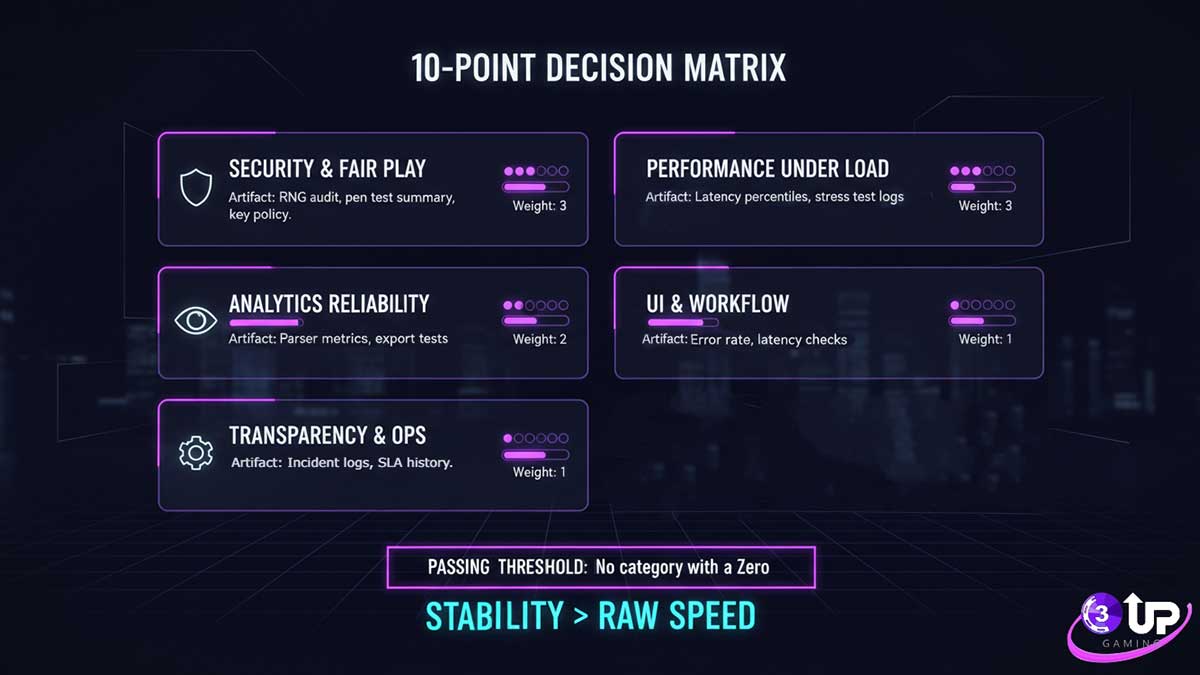
Passing threshold: There is no category which assumes the value of zero.
Switch trigger records net gain is that in which there are no new unresolved risks.
This is where the poker hand is finished.
You had tension before the flop. You had to think about it. The answer to this question is simple on the river: does this system behave predictably when the pressure is maximum?
The price of a migration has been saved to More Pros like no feature demo has ever been able to. This rubric is created to test a healthy poker software performance when it is stressed in actual operation. Intuition is defeated by decision literacy, all the time.
Lacking ideas on what to test with your poker software stack or re-test? Pick one of the stress tests above, request one audit artifact, check one dataset.
At 3UP Gaming, we work to ensure that players and operators develop such decision clarity, which will be reflected in sessions, bankrolls, or migrations.
No hype. Righteous systems that are put to test.
Key Takeaways (5 Key Features)
- Poker software must be considered a risk system, and not a feature bundle.
- Claims are less significant compared to auditable artifacts.
- Multi-table load introduces all the convergences of UI, analytics, security and performance.
- Failure points are likely to be mobile and communication layers in case of parity loss.
- A rubric is a simple rubric which works to turn the uncertainty to a decision.
Further Reading
Security Engineering: A Guide to Reliable Distributed Systems by Ross Anderson – This is a canonical textbook on cryptographic systems and security auditing, and can be put directly into use in the exercise of evaluating platform security claims out of marketing.
The Design of Everyday Things by Don Norman – Provides general principles of cognitive ergonomics and user-centered design, providing the theoretical base on the evaluation of the impact of poker UI on the burden of decision.
Poker Plays You Can Use by Ed Miller and Ryan Sleeper – Despite being a strategy book, it is a presentation of how raw data can be turned into actionable information, as it shows how analytics can be used in detecting leaks.
The RNG Standard: Requirements of Random Number Generators in iGaming ( eCOGRA/Gaming Labs ) – The official open standard of random number generator certification, which is the artifact of definitiveness in terms of procedural fairness of poker software.
TwoPlusTwo Poker Forums (Archived Strategy Threads) – A historical database of player-created analysis and case studies of the behaviour of software and bot detection and real platform failure, using experience in the community to determine the theory.
Optional Depth (internal interconnections).
- Standards of fair-play and RNG certification.
- Performance engineering and lateness testing.
- Analytics validity and fidelity of parser.
Glossary (Quick Reference)
- RNG (Random Number Generator): This is the system that determines the results of the cards; it has to be statistically audited.
- Parser Accuracy: The degree of the accuracy of hand history recognition into data.
- Latency Percentile: It is a statistic of worst-case response time and not averages.
- End-to-End Encryption (E2E): Secrecy of messages in a way that the sender and receiver of the message comprehend it.
- EV (Expected Value): Expected value of a decision in the long-run.
The system has ceased to be secretive.
It is no longer a question of choice.
The risk, lastly, can be quantified.
FAQ about professional poker software features
How to test the fairness and bots resistance in online poker websites on your own?
- Independent verification is founded on third-party RNG certification, published overviews of statistical tests and published algorithms of bot-detection. Fair platforms allow external audit, publish enforcement logic on high level and transparent records of incidences without revealing exploitable system information.
How can the metrics be used to ensure that all is stable during multi-tabling and peak traffic?
- The latency with load percentile, crash-recovery record and sustained uptime record are represented as stability. The average response times are too long, tail latency is to be monitored by operators, resource throttling behavior and outcomes of stress-test which is simulation of the actual tournament or cash-game spikes.
What are the UI features that allow effective multi-tabling, without the use of bots?
- Multi-tabling is a task requiring layouts which are configurable, can withstand randomization of inputs, and are designed to be interacted with by human beings. Deterministic, monotonic UI designs make bots more potential and density tuners, timing changeability make human play more viable and automation abuse less harmful without affecting the performance of human play.
What are the ways to assess analytics tools to rely on RTA and fraud detection?
- Stable analytics demand the accuracy of the parsers, integrity of the time stamps and the clear division between the post-hand analysis and the real time assistance. The operators will verify the correctness of the samples, test known hand sets, and make sure that analytics does not produce any signals that can be exploited to offer the prohibited real-time support.
What audit material would I want the poker software vendors to provide to me?
- The operators are supposed to demand RNG audit reports, penetration tests reports, encryption and key-management reports, uptime history and incident disclosure policy. The denial of high level artifacts is a red flag, despite any proprietary implementation information being concealed.
How to test cross platform data parity and security threats?
- The same hand-history capturing, similar authentication, encrypted sync and good reconciliation of disconnection should be tested in cross platform tests. The mobile and desktop clients should be synchronized to the same level of data; the loss of hands, slow synchronization, or loss of security through signal parity.
What will I do in the event of a possible suspicion of bots unidentified or RTA exploitation?
- Suspicion must result in the review of internal logs, anomaly analysis and escalation to the integrity team of that platform through documented channels. Procedural poker is based on constant surveillance, independent audits and regular updates on enforcement rather than the accusations or publics.