



Premium Turnkey Online Casino Solutions for Sale | Fast Setup & Compliance Included! One is tempted to start an online casino in the shortest possible time and the question is which turn key route will offer control, compliance and value in the long-term.
The compliance leads, risk, data, regulatory exposure and optionality are ownership issues to the operators. A good turnkey model is quicker regarding schedule but minimizes strategic choices.
How Does a White-Label Casino Platform Work?
A white-label casino service is pre-built infrastructure that allows an iGaming start-up casino to run under an umbrella license with in-built games, payment and compliance solutions; it removes friction on set up and retains branding.
This guideline shifts to the trade-offs to the capabilities to the clarity of governance.
What are high quality turnkey casino solutions?
Some of the items included in the premium turnkey casino solutions include package software on platforms, game aggregation, payment solutions, and foundational compliance services of the back-office operations, which are vital to be included in the contract.
Most white-label casino providers provide a nearly complete stack of front-end, wallet, CRM, routing payment and single-api integrations. The attractiveness is less complexity of integration.
Bundled, however, does not imply being unlimited. Aggregation and modular design is simpler to deploy, however, it is the operator, not the vendor, which has the licensing liability and regulatory responsibility.
Some of the major elements are listed below:
- Different casino games offered, slots and table games and live dealer games.
- Wallet and payment gateway system inclusion.
- The back-office control panel, reports as well as player management system.
- Connectivity to a KYC or AML system.
- Basic instructions or support on licensing.
- CRM and bonus system.
White-label casino platform is an ecosystem that includes everything an iGaming start-up needs to get going quickly. It provides thousands of games that are already linked to a common game library; supports multiple currencies with a wallet system and offers a range of essential services such as payment integration plus back-office tools.
There are other things which are not part of the basic package however. These may be extra services (for example) advanced analytics; personalised UX/UI design or it may provide personnel whose job is only to comply with regulations and laws covering gambling activities; all this could help reduce risk when setting up shop but might also cost more money if you want them!
The casino white-label solution seems to be extensive in marketing decks. In practice, the degree of customization, flexibility in reporting and the jurisdictional coverage are materially different among vendors.
At this point, the query changes to be not whether it is possible to launch fast, but whether it is possible to manage operational risk at scale.
Speed is the solution to entry. Survival is the rule.
The next thing is a practical checklist to make comparisons of offers.
Make sure what is in the contract before making a comparison with headline pricing.
Why are turnkey platforms more popular than custom builds with operators?
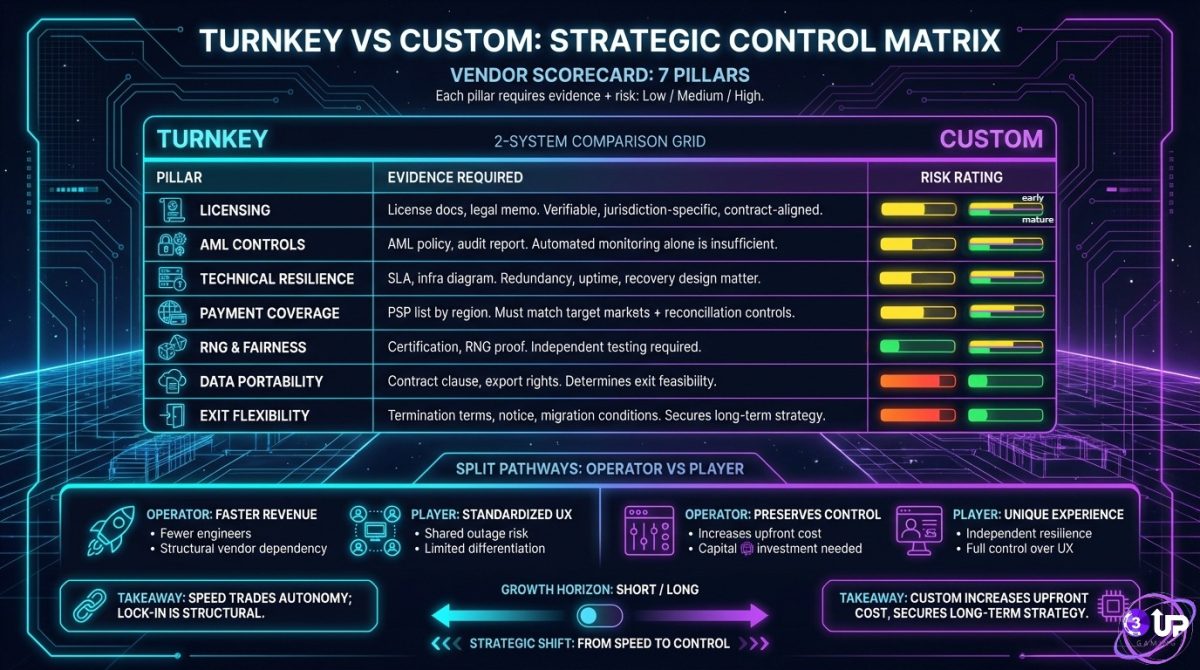
White-label casino platform: While it’s cheaper than building your own platform from scratch, and easier to customize than some other options, white-label deals do come with some downsides, namely, a lack of control.
This may not be a concern to you though, as an iGaming startup, you can go live within a few weeks on a revenue-sharing deal without necessarily investing in much infrastructure or manpower.
It is a trade off: You can be up and running fast at a comparatively cheap price, but you are constrained in what you can do. The pace of the platform launch can be a problem to the vendor, as well as giving the operator less control.
The operator is legally liable even in a turnkey vendor on the aspect of licensing and AML. Outsourcing is not done on responsibility. Platforms reduce technical overheads, and restrict customization of casino platforms and roadmap independence. The dependency of the vendors gradually becomes structural.
Implications of operators and players.
Operation route:
- Faster rate of revenue generation.
- Threat of shared infrastructure.
- Staffing engineering cutback.
Pathway of the players:
- Standardized experience.
- Delay or failure of various brands can be experienced.
- Lack of clear distinction of responsible gaming tools.
It is not formal, but formal conflict.
Choose turnkey since it is quick. Choose custom as strategy control.
Next: the feature set that makes the difference between premium and commodity.
What are the main characteristics of a high-end online casino solution?
The high-end platform will involve scalable architecture, high-level security, flexible payment, player-life cycle intelligence, and transparent compliance process, but will be costly to operations and governance of each of the add-ons.
All reputable software providers of casinos promote modular and scalable core systems with single-API integration. The phrase sounds efficient. It often is.
It can also centralize risk.
Casino software (scalable casino software) basics.
The high-end platforms usually consist of:
- Microservices architecture.
- Horizontal scale abilities.
- CDN distribution.
- Unnecessary hosting environments.
- Latency SLAs.
- Real-time analytics.
First-mover white-label casino providers integrate AI-based fraud detection and real-time KYC software to help get ready to comply quickly in regulated markets.
Scalability is not a theoretical concept but a working concept. Horizontal scaling and redundancy are required in times of traffic spikes. The vendors increase the resiliency, and the concentration risk takes place with single-API aggregation: when a problem is met with the integration layer, the content stops.
It is said that speed brings exposure. This means the faster things go the broader the scope or area that is affected. As per the opinion of the operator, safety measures include KYC, high quality RNG certified systems, anti money laundering, and timely fraud detection.
Today the operators have a handful of safety, and fairness measures- KYC/AML (Know Your Customer/ Anti Money Laundering), RNG (Random number generation), and verifiable fairness.
High quality products providing services to the online gaming industry have certified RNG systems, inbuilt fraud detection system, and also the KYC/AML facilities.
Majority of the payment integration systems offer multi currency wallets along with crypto rails. But there are other problems as well as perceived by the players.
The operators believe that fairness testing should be autonomous and the whole game session should be carried out without latency. The mechanisms should be transparent to all the players in terms of withdrawal.
If the operators do not integrate these safety measures with a great deal of accuracy their exposure to the regulator increases multifold. Usually KYC accuracy impacts operator’s regulatory exposure, and a high degree of tolerance is maintained for low and average accuracy, but tolerance levels become very low with further drop in accuracy.
The failure to detect AML increases legal risk. Flexibility in terms of payment makes reconciliation more complex. Compliance support can be packaged in a licensed casino platform. It does not internalize the regulatory role.
All the other features: real-time personalization engines, AI-based retention scoring, cross-border payment rails; it is these that become revenue generating. It also adds an audit surface. You are now confronted with the fundamental quandary which is speed and convenience versus long-term control and compliance load.
In the middle of this decision tree, there is the question of architecture that is governance. Are you willing to be centralized to be dependent on vendors? Or do you re-engineer controls to assist in eliminating such risk?
The solution decides all the downstream.
What is your opinion about a turnkey casino solution and how do you assess it before purchasing?

To start the business of online casinos in a responsible way, apply a systematic rubric, which is based on the compliance to ownership, architecture, payment, game and exit flexibility. Request them to confirm on a written basis and not assurance.
Licensed casino platform can reduce market entry to 4-8 weeks compared to custom build that has to be licensed and assembled independently.
The trade-off can be seen: white-label and turnkey models will speed up the launch but reduce the probability to control in the long-run. Licensing and AML requirements are legally granted to the operator body.
Evaluation must, then, be more of control, data portability and risk calibration; and not depth of features.
The vast majority of the white-label casino operators are Curacao or MGA based so that the operators do not have to enter into the process of obtaining the licenses on the long-term basis but still have the contractual obligation to control the compliance.
The risk of narrative is minimized with the help of independent audit evidence. The lack of documentation makes it better.
Poker Risk Calibration: In Detail.
- Pre-flop: Determine the types of risk to be committed to.
- Flop: Compare the recorded evidence by various vendors.
- Turn: Evaluate any possible losses in every direction e. g., regulatory, financial and operational.
- River: It is only worth putting into it what you can risk losing.
- Showdown: Be sure that all promises are documented.
Emotion-based decisions are punished in poker in case of unclear odds. The same applies with platform procurement.
When the vendors are scored, then the compliance and payments deep dive follows.
When assessing operational flow, consider licensing, compliance & payment integration risks.
Legal exposure, revenue flow and trust by the players are determined by casino compliance services and casino payment integration.
With a start-up casino, which is an iGaming, crypto-friendly payment systems are trending, provided the AML transparency is not lost; the operator is the licensed one.
In this instance efficiency is being improved and audit scrutiny enhanced by the basis of automated identity checks and AI-based surveillance.
There is an AI-readability principle that is in play:
- All automated decisions have to be explicable.
- There should be manual bypass routes.
- Decision logs are required to be maintained.
- False-positive and false-negative rates should be controlled.
- Regulators should be capable of reconstructing decisions.
Minimise compliance risk by going to an explainable AI. The opaque AI is the maximising compliance risk.
Reconciliation controls, payment rails and multi-currency.
Multi-currency wallets and crypto options will also be common in a payment integration, and they will extend market reach. They also make reconciliation and chargeback exposure difficult.
The payment architecture has a direct effect on the liquidity forecasting.
Ethics: Equity and Responsible Gaming.
The trust of the players is based on the checks of fairness and safe responsible gaming.
All the players are entitled to:
- Having the RNG tested by an independent third party.
- The payout percentage has to be transparent and open.
- The withdrawal policy should be easy and clear.
Responsible gambling should imply that gamers must be provided with resources and capabilities like deposit limits, self-exclusions, behavioural monitoring triggers, cooling-offs etc.
Here player pathway obligations cross over into operator liability. A lapse in responsible gaming is not a reputational one. It is regulatory.
Compliance and payments should not be treated as extra perks of a vendor.
The last part will be the synthesis of decisions and further actions.
Key Takeaways
- Turnkey is fast to launch and dependency is centralized.
- The operator has a liability of licensing.
- There is structural concentration risk that is caused by single-api efficiency.
- Audit surface increases because of feature depth.
- Facts are more important than the seller’s story.
- Exit Strategy safeguards long term strategy.
- Survivability is based on compliance architecture.
Uncertainty reducing framework is a decision framework. The exposure is reduced by way of documentation.
The criteria to use when assessing premium turnkey casino solutions include structured scorecard, independent legal review commissioned, and sandbox testing prior to commitment.
When comparing the suppliers of online casinos, emphasize playbooks of migration written, and explicit rights to export player data to reduce vendor lock-in.
Second, approach decision, first, launch product decision.
Further Reading
External Sources
- UK Gambling Commission: Remote Gambling and Software Technical Standards (RTS).
Technical standards of compliance that are set by regulatory authorities on remote operators. - Information security Standards ISO/IEC 27001:2022.
Global information security management and risk management. - Gaming Laboratories International (GLI) Standards.
Standards of independent testing of a gaming system and certification of RNG. - Vixio GamblingCompliance Industry Reports.
Market intelligence of jurisdictional and regulatory trends. - The Guidelines of the International Association of Gaming Regulators (IAGR).
Regulatory cooperation and oversight professional advice.
Internal Links
- The basics of Online Casino licensing.
- Risk Management of iGaming Operations.
- Responsible Gaming Systems Design.
Glossary: Major Terms in this Article.
- Turnkey Platform: Ready-to-go casino systems licensed to the operators.
- White-Label Model: Vendor owner, operator brand: Vendor owns and operates brand.
- KYC: The process of verifying the identity of the customer.
- AML: Anti-Money laundering transaction monitoring system.
- SLA: Service Level Agreement of the uptime and latency.
- Vendor Lock-in: Reliance in the design that limits the maneuverability of exit.
- Horizontal Scaling: This involves the addition of servers to handle the increase in traffic.
- Explainable AI: AI systems the decisions made by which can be audited.
FAQs about white-label casino suppliers
What will it cost to launch a white-label casino platform in 2026?
- Depending on many factors including licensing coverage, payments integrations, customizations and revenue split, the prices can be between $15,000 and 150,000.
How long do iGaming startup casinos take to launch?
- Industry Most iGaming start-up casinos can be deployed on a licensed white-label casino within 4-12 weeks as opposed to 6-18 months to develop a custom one.
Do white-label casino suppliers offer gambling licenses?
- Many of them are umbrella licensed such as Curacao or MGA systems, which allows operators to begin operating sooner without regulatory responsibility.
What are the major distinctions between turnkey and white-label casino solutions?
- White-label solutions are speedier and shared licensing infrastructure, and less rich technical ownership and architectural control more characteristic of turnkey or custom solutions.
Are there crypto payments by modern online casino suppliers?
- The majority of the modern ones are the combination of crypto-friendly wallets and local alternative payment methods, which fall under the jurisdictional compliance controls.
Which KYC and AML solutions are the most significant to a licensed casino platform?
- In order to provide compliance integrity, real-time identity verification, automated AML monitoring, transaction risk scoring and explainable AI audit logs are required.