
Proven White-Label Casino Suppliers for iGaming Startups and Operators! White label casino pitches often claim to have the freedom of customization through the use of a plug-and-play, but platform architecture will often dictate what can and cannot be customized.
Fast is very tempting to launch; the cost of finding out that there were latent compliance, payment or scalability constraints after the launch has been made will be expensive. When it comes to any iGaming startup casino, the white label casino supplier problem is not so much about speed, but more about how much control you would lose in the future.
What does it mean by a white-label casino supplier?
A white-label casino company provides a licensed and prepared gambling platform which an operator can repackage and launch within a limited duration of time. The supplier has control over core technology and compliance and the operators control marketing, players and continued regulatory obligations.
This is not a hypothetical tension in the event that you happen to be a tech-savvy iGaming founder or operator and you are considering white-label casino suppliers. And that is why there are so many platforms on day one and fixed on month six.
Assumptions are audited in this paper, not ranked by suppliers or software sellers. You are not here to be convinced, but to be acquainted with the mechanics of it such that you know whether a white-label casino platform is favorable to your growth plan; or whether in an unspoken manner will discourage it.
The system also is what you will have in the auditor and regulator; modules, boundaries, obligations, and modes of failure. There is no hype, no shortcuts, no other than mechanics.
What you are going to get (you will not be told how to do it).
You will know what white-label platforms really consist of, where control literally ends, why startups resort to them and what features cannot be omitted under the existing regulation standards. The trade-offs are to be seen, though not determined yet when you come in the middle.
What is in a white-label casino platform; and what is not?

On the surface of it, a white-label casino site or a casino white-label offering seems like a fully-built house with your brand on the door. In reality, it is more like a furnished apartment: habitable, acceptable, but with building regulations of which you are not the author.
The standard white-label casino platform is a stack which packages multiple basic systems together. These are not certain incidental extras, but bare minimum infrastructure to operate within remote technical standards.
The basic elements of the system tend to be:
- A Player Account Management system (PAM) handling the registration, wallets and bonuses and sessions tracking.
- Certificates of RNG and RTP reporting aggregation of games.
- Makes wire payments to particular PSPs with the pre-determined direction of transactions.
- KYC compliance modules, AML screening compliance modules and audit logging compliance modules.
- Reporting levels to address the fairness and traceability requirements of the regulators.
The elements exist to address the system integrity requirements and certification models and not operator ingenuity. They are to be stable, auditable and reproducible; which regulators deem more vital than flexibility.
It is the expectation that is broken.
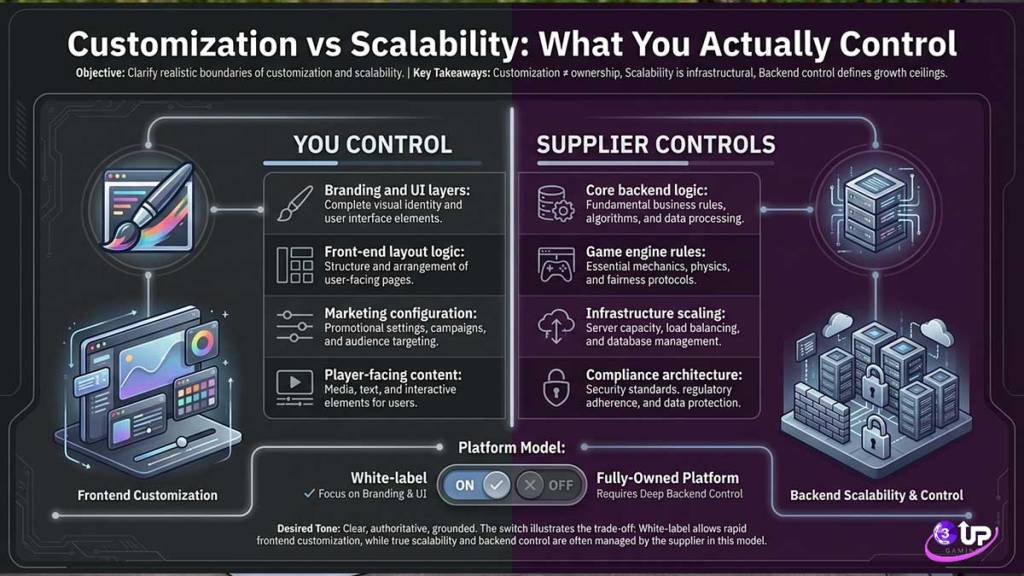
Branding is a superficial entity: domain, UI skin, language, promotional logic. Back end control is more of a layer, within a multi-tenant architecture, whereby infrastructure is shared and data is segregated. The design alternative maintains the expenses to a minimum and implementation to be fast, yet it also holds large parts of the system together. It is the natural trade-off of any licensed casino service that is operating on a shared and multi-tenant platform.
The reason why one of the founders took complete control was due to the appearance of a dashboard that was comprehensive. Once they were launched they discovered that the payment flow was complete; they could not change it and certify it. The system was not broken.
The operator will not stop having responsibilities just because a supplier is licensed. The conduct of the marketing, the protection of the local players, the responsible gambling, and the compliance which are jurisdiction specific are left to you. Delegation is partial in nature.
We thought that white-label was less committed. It, in fact, meant more obvious ones, and less room to make up. — Operator, EU-licensed brand
You are dealing with the first-moment of constraint. A hint of what is embedded before committing is the difference between tactical approval and expenditures shock.
Why and when is it used that startups use white-label despite such restrictions?
When white-label platforms are associated with inherent limitations, why do intelligent teams continue to use them? This is why the white-label and turnkey casino solution models are still competitive despite their limitations particularly to founders who want to develop online casino products within a short time.
Speed is the game changer since mathematics is the one that evolves with speed.
White-label is not about perfection in the case of an iGaming startup casino. It is all about getting into the market before capital, patience or regulatory weariness wear out. Infrastructure failures that have been ready certified would save the time taken to take years before it is realized.
Multi-tenant cloud systems use audited elements, which minimizes deployment friction. Security frameworks that are in line with ISO-grade controls reduce the workload of creating data protection frameworks. Early onboarding is done through licenses that the suppliers hold.
Such a trade off is rational; in some conditions.
White-label makes sense when:
- The uniqueness in architecture is not a priority but market validation.
- The supplier has a scope which is under your target jurisdictions.
- Your platform of growth is liberal of pre-programmed payment rails and game libraries.
- Your department is lean to carry out marketing and operations as opposed to systems engineering.
It breaks down in case speed is equated to scalability.
After a small team had been launched within record time knowing the limits of the backend. They had a plan that presupposed a small growth and short-term learning. The decision was made because of restraint and not because of the software.
This is the secret of all turnkey casino solutions: you are purchasing time, not liberty. The demand and learning player behavior needs to be tested. Time to make a decision on whether it is worth the cost to have a deeper control in the future.
Stop here.
That is all you have just witnessed, the trade-off between speed vs. control.
The implicit question to this is simply blunt and clumsy:
- Is it haste that you will lose the control over?
Which are the most important features that a can purchase white-label solution can purchase?
Strip away the marketing language and all white-label solutions of a casino are whittled down to the identical non-negotiables. These are features that the operators do not require, but the regulators impose. In this case, we shall be taking the step-by-step guide.
First, start with fairness.
RANDs will be certified, reproducible and auditable. RTP reporting is not a dashboard option, it is a regulatory measure that is connected with player protection. Audit logs are supposed to be capable of rebuilding activity in a non-ambiguous way.
Second, move to compliance.
These compliance services offered by casinos are differentiators of nothing; the lowest price of not being a criminal in regulated markets.
The KYC and AML systems are automated identity checking and risk rating systems, which do not eliminate human judgment. Manual escalation is meant to be done on high risk cases. This is not inefficiency, it needs to be frictional in order to deter abuse.
The security should then be covered in your move.
There should be high encryption requirements, access control requirements and incident-response requirements in the payment and player data processing. The aligned controls are not as innovative and more provably disciplined as those aligned with ISO.
One operator even disregarded the RNG certification schedules to do the same quicker. That did not allow flexibility, it allowed audit delay, launch deferral and reputational drag that was more extended than the shortcut saved.
Any licensed platform is made up of these casino compliance services. They are bulky, official and consciously slow to adapt.
Here the tension is created, and all the obligatory variants make it weighty. Protection of any kind curtails improvisation. However, even in their absence, the platform comes under scrutiny.
In places where founders lose the scale.
The majority of founders think that scale is a traffic issue. It happens to be a system permission problem. Scalable casino software will begin to strain at some point depending on the limits of concurrency, audit envelopes and payment routing rules.
What are the limitations and dependency risks and how they are destroying your plans?
This is where the hand turns. This has hitherto been a restriction in theory. They are reflected in the reality in a loud state; traffic peaks, payment peaks, cross-border onboarding. Multi-tenant architectures make use of the resources of certified performance envelopes. Certified performance envelopes are real.
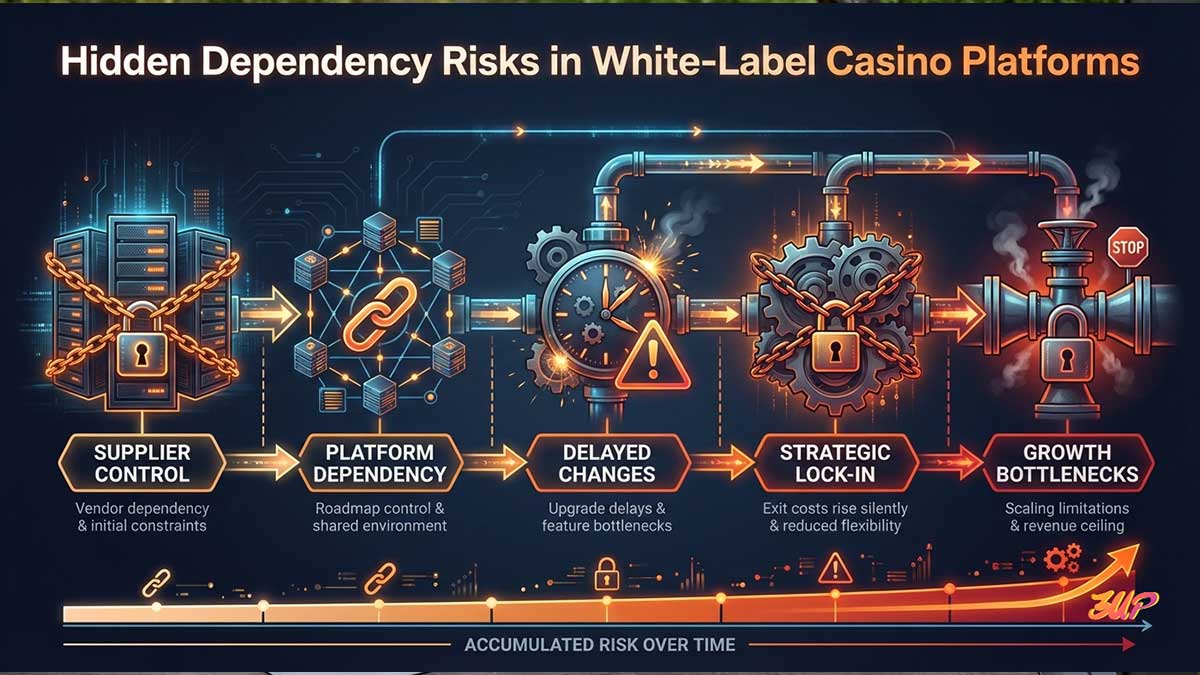
The concurrency limits are not the marketing figures, but tested limits associated with the certification. There is a rush in a tournament or a promotion and latency follows. Money is in hand. Sessions are lost. Gamers are lost.
Migration is the second trap.
The fixing of payment rails is done as well as game libraries in supplier ecosystems. Substituting one with the other is not many times clean. The idea of data portability exists in theory, but re-certification, re-checking of players and renegotiating of PSPs introduces a lot of friction to the exits.
Then there’s compliance drag.
The risk-based AML rules provide the manual review directions at the points where the automation appears to be the most appealing: high-value customers, high-speed deposit, cross-border transactions. The problem that will lead to bottlenecks which cannot be coded off is the scaling acquisition and not scaling review capacity.
It is only worth reading this section in case of aggressive scaling or you should run peak-load events.
The opposition between physics, regulation, and common infrastructure, in this case, takes place and the fast launch stories collide against them.
One operator got to know this when playing in a flagship tournament. Concurrency ensures that cascading failures triggered will not take place, it does not crash, it only slows down the process to the point where confidence is lost. The churn of players took place. The system behaved in an accredited way. It was something that was not taken into account in the plan.
This is the climax in the middle. The machineries can now be seen. The threats are not hypothetical. They are systematic and unresolved, predictable.
And the question hovering about it is not, is it possible to do white-label work, but can you place your own story of development in the frames of another. The answer is yes. Just not yet.
Payments, KYC and AML: What can be possible?

The real truth is that the effect of casino payment integration and KYC / AML casino processes on market access is much higher than branding or game choice will be. Payments and compliance are circulatory, in case that is scalability. Even when at work, you do not even see them.
That is where most white-label launches simply stagnate. This is where the operators are informed that a casino software company can automate the checks but not prevent the escalation of the regulations.
The payment rails are domestic and not overseas.
The other myth is that a casino platform is normally accommodative of payments. In fact, payment processors’ coverage is market-based, license-based and compliance-based.
What seems to be a simple integration process has a couple of hard requirements:
- PSPs are not selected by the local authority.
- The payment methods greatly differ by the region (cards, wallets, bank rails, crypto).
- Each rail has its transaction monitoring and reporting needs.
At one point one of the founders had made a regional launch and found out that the gateway they had chosen was not paying local deposits and also withdrawals were not. It was regulatory rather than technical.
This is the reason why you can silently decide on casino payment integration to decide which markets you will be able to serve, and which ones cannot be touched at all.
The KYC / AML casino processes are intentionally uncivilized.
Fast systems of KYC / AML casinos are not designed to be fast. They are justifiable and defensible.
The high-risk cases are to be mandated to be raised to manual review by the risk-based models alerting the anomalies. This impacts:
- High-value customers
- Quickly depositing customers.
- Cryptocurrency flows/ cross-border flows.
Fraud detection models can only expose the risk on the surface, not close the loop. Human judgment is not a point of breakdown, but instead, it is a regulatory condition nowadays in a transition of meanings and groundworks.
This is where the growth plans come into conflict with reality. The presentation of autopilot is a beautiful word. Real volume is observed to have manual queues. slowness of throughput. team scramble.
This is the reason why: the capacity to comply cannot be detached with your acquisition strategy.
What will be the customization and scalability you are likely to get?

What will be the customization and scalability you are likely to get?
Superficially, white-label platforms can be customized. Colours can be altered. layouts can be exchanged. promotions can be altered. It is like control. Colors change. Layouts shift. Promotions rotate. It feels like control.
Then one of them requests to invert the logic of the wallets.
It is at this point that the boundary is hardened.
Front-end freedom Backend stability.
The personalization of the casino platform is on two planes, one of which is quite different:
- Themes, branding, language, lobby design, Bonus presentation: Front-end layers.
- Back end wallet flows, payment sequences, risk scorecard and audit trail are then followed by business logic.
It is weakly differentiated intentionally on the front-end. Backends logic is inflexible as it was designed.
Why? Since backends may be modified, therefore invalidating certification, or disrupt auditability or modify reproducible logs. It is not a preference of suppliers, rather requirements of standards.
The background of one of the brands cost a lot of money to streamline the flow of players. The outcome was not innovation. The first budget was increased with it being testing, re-certification and doubled costs.
Between envelope scale – multi-tenant.
Multi-tenant systems are horizontally scaled and cannot be customized by tenants to provide stability of the platform. Certified limits are used in resource allocation, concurrency and performance.
That is why the scalable casino software does not mean infinity in elasticity. Put to the test one can predict the behavior. At this point, the distinction between a platform vendor and a long term iGaming solutions provider can be seen.
This is also the case with migration planning. White-label stack switch-off is not a project, but it has:
- Export and integrity of data.
- Player re-verification
- Payment rail replacement
- Re-certification cycles.
Migration according to early planners of migration is considered to be a strategy. The ones who do not experience it as a crisis.
Reorient before judgment
Verify your assumptions against the reality and make evaluation and decisions only after checking your assumptions against the reality, take a moment and put pressure on your assumptions:
- Did you observe concurrency load performance and uptime load performance?
- Are you in favor of KYC and payment rail supported target markets?
- Are terms of migration given, or is there proposed?
- Does the certification evidence date back, or is it outdated?
Whenever indeterminate, an answer is not a free one.
The way to evaluate and filter a good white-label supplier.
During shortlisting of online casino suppliers, promises are not necessary but evidence is a requirement. At this point, it is deadly, intuition. The filter that you need is a standards-anchored filter.
The analysis of the white-label casino suppliers is not related to features; it is associated with evidence.
Due diligence is suggestive of things that count.
The following may be fixed, not assured by responsible suppliers:
- Adherence to distant technical norms and certification systems by means of gaming.
- Standards of uptime platform and parallelism.
- Documentation and versioning of Open API.
- Jurisdictional coverage on the clear payment processors.
- The ownership of data and migration will be defined.
- Certificates of security on information about players and payments.
One of the founders got out of an expensive contract by asking one question: “Give me your migration path.
None of that. Negotiation is not aggressive but is rather diagnostic.
The supplier is selling more than what he or she is writing. It is not indifference to provide measurements. It is a sign. That is where evaluator mode replaces buyer mode.
Evergreen to players: Understanding how fairness, RTP, and responsible gaming operate.

The white-label platforms do not only have an impact on the operators. They specify the gamer experience as well.
Auditability is provided in any licensed casino site to safeguard the players and the operators in case of disputes.
Knowledge about RTP and auditability.
RTP is not a guarantee. It is a statistical quality which is enforced by certified mechanisms. Players can:
- According to game review RTP disclosures.
- Evidence of certification is required.
There is a conflict as such; then it is natural that it results in a reproducible audit trail conversation.
After a flag that was raised by one of the players against a suspicious RTP behavior, an audit showed a configuration error; not manipulation. This was a good system because it was auditable.
Responsible gaming is not cosmetic.
Standards are self-exclusion, deposit limits and session controls; however, their enforcement depends on the jurisdiction. These tools are to be the defensive infrastructure of a player rather than settings.
Their job is to provide them on the platform. It is his duty to get them forced by the operator, and the duty of the player is to use them.
Key Takeaways
The picture is finished at this stage.
There is no shortcut to white-label platforms. They are concessions arranged in order. They sacrifice freedom to expediency, self-sufficiency to conformity and personalisation to predictability.
The successful founders are not the ones who keep their promises. They are the ones who demand standards that can be verified, limits that are documented and limits that are explicit.
One other narrative is to be distributed.
The concurrency logs were requested to be signed by one of the founders, but the supplier was reluctant to do so. Six months later, one of the rivals on the same platform experienced a public outage at the time of peak traffic.
No drama when it is all about preparation.
To any operator who is dealing with white-label casino suppliers, success is not about the most flexible system. It is a matter of trading-offs that you can live on. There is a narrow margin between constraint and catastrophe and it is nearly invariably diligence.
Further Reading
- Gaming Laboratories International (GLI-19, GLI-33) — Interactive gaming system certification standards; defines testing, performance and audit standards.
- Financial Action Task Force (FATF) Global AML/CFT framework — The definition of the risk-based control and the obligatory enhancement of the high-risk gambling streams.
- Malta Gaming Authority (MGA) Regulatory Guidance — It creates operator functions that it cannot fully outsource to the suppliers.
- Standard ISO/IEC 27001 — International standards of guaranteeing the security of data of players and payments on controlled digital platforms.
- AWS Well-Architected Framework — The concept of multi-tenant cloud resources allocation and scalability restriction in the event of the collective casino infrastructure.
Internal Anchor Text (3UP Gaming).
- white-label casino risk analysis.
- casino platform compliance framework.
- scalable iGaming infrastructure guide.
Glossary: Major Terms in this Article.
- White-Label Casino Platform: This is an online casino platform that a supplier provides that enables its operators to operate under their own brand but share common underlying infrastructure and compliance regimes.
- PAM (Player Account Management): This is the central system that handles player identities, wallets, bonuses, sessions and transaction history of an online casino.
- RNG (Random Number Generator): An accredited algorithm that makes the results of the game random and determinable, which facilitates fairness as well as auditability of the regulator.
- RTP (Return to Player): This is a statistical value that represents the percentage of wagers returned to players over a long period of time, which are confirmed by certified testing and reporting.
- Multi-tenant Architecture: A platform architecture in which multiple operators are operating on the same underlying infrastructure and in which player data is logically isolated.
- KYC / AML Controls: These are the procedures to ensure the identity of players and track transactions, which involve automated screening and manual screening of high-risk transactions.
- Remote Technical Standards (RTS): Regulatory provisions on fairness, security, auditability and integrity of operations of licensed online gambling systems.
- GLI Certification: The independent testing and certification of casino software which assures that it meets international standards of performance, fairness and security.
FAQ about white-label casino suppliers
But what is a white-label casino supplier?
- A white-label provider of casino is a pre-built gambling site that can be branded by an operator and introduced under their brand. The core technology and compliance stack are controlled by the supplier, whereas the operator is concerned with marketing, players, and day to day operations.
What is the speed of iGaming startup using white-label systems?
- The iGaming startups can most often be launched within weeks and not months due to the existing platform, integrations, and certifications. Still real timelines are based on branding establishment, regulatory onboarding, KYC preparedness, and payment approvals, which tend to cause unavoidable delays.
Are white-label suppliers license and compliance comprehensive?
- White-label suppliers typically offer a license structure and compliance system, but operators remain legally liable in the marketing practices, protection of players and jurisdiction related requirements. Compliance is not transferred, but it is shared, and regulatory risk can be still faced by the operators.
Which games are included with white-label casinos?
- White-label solutions are usually pre-integrated casino games with licensed studios, including slots, table games, and live dealer products. Game libraries are hard-coded to approved aggregators so operators have the option of games in the library, but seldom add unapproved games.
To what extent are white labels solutions customizable to unique branding?
- White-label solutions have a high level of front-end customization (logos, themes, layouts and promotions), but the logic behind it is highly regulated. Any wallet operations, payment operations or game behavior are generally restricted to ensure certification, auditability and platform stability.
What is the payment and KYC of white-label casinos?
- Payments and KYC are administered by approved providers that are market and regulation specific. Automated checks are imposed on the standard users and manual verification on the higher-risk players. This may slow down the onboarding process and limit the areas or payment options that an operator can accept on a licensed casino platform.
Is it really possible to scale white-label platforms with business?
- The white-label platforms are built to pre-determined performance standards of certification and shared infrastructure. They do not experience problems with early growth, however, concurrency limits, set rails of fixed payment, and migration problems can arise as traffic increases and long-term scalability is a strategic constraint.
What are the priorities of operators when selecting casino suppliers?
- Verified licensing coverage, transparency of compliance, access to payment and KYC, scalability evidence and clarity of data ownership should be the priorities of operators. The fact that audits can be proven, that there is a history of uptime or that it can be migrated is more important than a list of features or a marketing claim.