
The GGR Poker: 6 Professional Measures that iGaming Sites use! The only metric that operators rely on to determine the health of their platform in poker is GGR. This is not synonymous with profit. Here investors, regulators and experienced operators can start. They can start with the essential information about a poker platform.
It is common to find most players touching tables, reading cards and looking at the displayed results. The operators perceive flow, friction and signals. The first indicator is GGR (Gross Gaming Revenue). It tells them either that a platform is breathing or is suffocating softly.
This article opens up the system.
What is GGR in poker? 2025 Key Concepts.
The amount of rake and tournament fees that are collected by a platform are referred to as GGR (Gross Gaming Revenue). This is calculated without tax, bonuses or expenses. It is a metric of platform activity and scale of revenue and not of profit or losses of players.
What You’ll Learn
- What GGR really is (and what it is not) in poker.
- The reason why iGaming platforms consider GGR as a health indicator, rather than a scorecard.
- Calculation of GGR in actual online poker situations.
- The six metrics of GGR movement diagnosis operators.
- The role of GGR in influencing poker revenue models and experience.
- In cases where GGR assists, and when it deceives, decision-making.
This has been transparency of the operators, turned into analysts, affiliates and hardcore players.
The Question of the GGR (Gross Gaming Revenue) in Poker?
It is high time to know about this term!
The GGR (Gross Gaming Revenue) refers to the amount of money that a poker platform gathers out of rake and tournament fees. This is without deductions. Bonuses, promotions, taxes, operation expenses or affiliate disbursements are examples of deductions.
Stated so simply: GGR = rake + tournament fees received.
What GGR is not:
- Not profit
- Not net revenue
- Not pure player losses
Poker is a people-to-people game. Winners are not found at the poker table, they are found at the house. GGR is used to calculate the revenues of the platform to operate the game, not the total losses of the players.
GGR is a measure layer, the score board and not the result. Looking at the pre-flop. This is the stage where the chips have been bet. But the results are not determined. Thus that pre-flop figure is GGR; not final.
The importance of GGR to iGaming Platforms.

Here’s why operators care.
GGR is the common language of the iGaming platforms. It has established it among the operations teams, regulating bodies, investors and auditors. They ask about GGR before anybody questions about profit.
Why?
- It checks the health of the liquidity.
- It measures scalability.
- It assesses the adherence to the regulations.
- It quantifies the heightened openness of the stakeholders.
- It quantifies the heightened decision-making procedures.
A platform whose GGR is volatile or falling is not just under-earning, but it is unstable.
Constant GGR is an indicator of predictability. Capital, alliances and regulatory trust is lured by stability. Investors do not read marketing decks. They read GGR lines.
The Calculation of GGR in Online Poker Games.
Calculating GGR on paper is a very simple task, but in reality it can be a complex task. These are the aspects which are taken into consideration.
The Core Formula
GGR = 100 Total rake collected + tournament entry fees.
What Complicates It
- Pot-based vs. time-based rake
- Tournament overlays and guarantees.
- Jurisdiction-specific taxes
- Loyalty and bonuses that negate revenue
Worked Example
- Cash tables will produce EUR80,000 in rake.
- Tournaments increase EUR20,000 in fees.
- Total poker GGR = EUR100,000
The determination of what can be deducted to promote allocation of the network pools may be a daunting task. And what various outcomes can be realized using the same GGR may also be a daunting task. The question might look easy. But the implications and the details involved are far more complex. These are critical to the outcomes in this field, and knowledge of them is essential to anyone in this field.
The formula is short. The implications are not. It is here that the poor operators confuse easy math with easy decisions.
The 6 best GGR analysis metrics in poker.
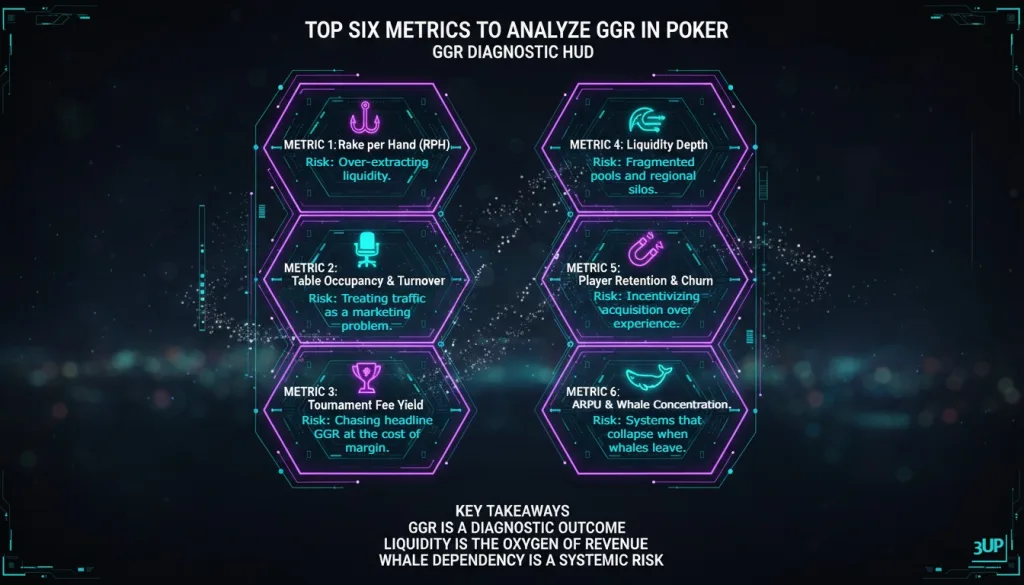
GGR is in motion due to something that is below it. These six metrics explain why.
Rake per Hand (RPH)
Establishes the revenue that each hand brings forth. Extraction of liquidity is the decision risk. High RPH can cause inflation of short-term GGR. And send players away.
Table Occupancy & Turnover
Unoccupied seats are worse than bad rakes in killing GGR. Occupancy is good which ensures a continuous flow of rake. Bad UX indicates bad turnover. Risk of decision is due to the fact that the decision to position the traffic as a product issue. Not a marketing issue.
Tournament Fee Yield
Tournaments promote GGR, but only in the case of successful participation. Publicity can be enhanced with the help of guarantees. Overlays are the only erosion means of nets. Risk in decision-making is what makes headline GGR as it is likely to erode steady margin.
Liquidity Depth
The more hands that were played, the more decisions that players will make. The more rake will be, and, thus, the threat of your decision will be. The threat of regional fragmentation and silos will be.
Player Retention & Churn
Returning players, not new players, save GGR. Revenue curves and levels variance. The rewarding experience is one of the factors. This determines the decision risk in comparison with the acquisition.
ARPU (Average Revenue per User) and Whale Concentration.
Rake designs, tournament, network sharing and white-labeling economics are important factors to consider. Long-term stability does not rely on one big win. It is anchored on steady and consistent strategies.
The GGR role in Poker Platform Revenue Models.

The main concepts that bring about a high degree of clarity are the following. Rake structures, a hierarchical structure that resembles a rake, are important. Tournament structures, a structure that is based on competition. It resembles a tournament and is also important. Network pooling, a combination of resources or entities within a network. It is another important concept.
Lastly, white-label economics is the last of all the enlightening concepts. It refers to the economic models that are optimised on white-label products or services. When GGR is growing and retention is declining, then the model is weak. When the GGR is growing and retention is declining, then the model is weak. When you win a big pot, it does not mean that you are playing well.
The role of GGR in enhancing player experience by iGaming Platforms.
Ethically speaking, platforms use Gross Gaming Revenue (GGR) information to serve many purposes. These aspects are adjusting the pace of the table. User experience will be improved to the greatest to enhance the involvement.
They also use GGR information to preempt and forestall cases of abuse and collusion. This is to provide fair play. Moreover, GGR shapes the promotion strategies. It also makes decisions about which players should be rewarded and in what way. The final aim is to make the matchmaking experience fun and enjoyable to all players. Increasing the fairness of the matchmaking algorithms is the most important step towards this end.
Three Steps: If You are a Player: Player Learning Guide.
- Watch table fill rates
- Equalization of track tournaments.
- Design vs rake pressure Notice loyalty design vs rake pressure
Securing the players secures revenue. Players do not feel that sustainable GGR is there. That’s the point.
GGR vs. Other Poker Revenue Metrics.

Poker metrics can be used to comprehend the performance of a poker platform. They also help understand the activity of the players. These metrics give an idea of various parameters of the poker ecosystem. This includes the general activity and player value. Remember these key metrics:
- GGR: Scale and activity
- NGR: Profit reality
- RTP: Casino based, non-peer to peer.
- ARPU: Player economics
Get a high level overview of the scale and activity of the system using GGR. Test the financial performance, fairness of the games, and economics of the players of the platform. Do this with NGR, RTP, and ARPU, respectively. When compared, these metrics give a holistic picture of the performance of a poker platform.
The best GGR to maximize profits in poker.

Optimization does not focus on maximization, but on restraint and sustainable approach. The most important best practices are to make small rake adjustments. This is to optimize processes without excessive resources. Liquidity engineering is an essential part of the stability of the flow of assets. It also ensures operational stability.
The moral AI is required to keep the performance steady. This should happen at the time when the business is at the lowest point. This promotes ethical and trustful outcomes. Moreover, a regulatory-sensitive design will ensure compliance with the legal framework. It will also enable long-term sustainability and reliability.
3-Point Test Pre-rake Change.
- Will retention drop?
- Will liquidity thin?
- Can UX absorb it?
Spikes in GGR in the short term tend to generate long-term decays.
Key Takeaways
- GGR does not stop but it starts.
- Poker GGR is not house-driven, but rather rake-driven.
- The metrics describe the movement of GGR.
- Sustainable GGR is in line with the player experience.
- Ethical design is revenue protection.
Further Reading
Regulatory/Compliance Framework.
- European iGaming Compliance Report of 2025: Provides the recent changes in regulations. This involves certain tax increments and new compulsory taxes in the European markets. Base your “Regulatory & Ethical Framework” on the realities of the present day fiscal situation. This shifts the discourse to operator reality that is practical.
- Europe Non-Compliance Struggle Analysis: The commercial tension of non-compliance is experienced by operators. It is between compliance and profitability. It quotes fines of more than EUR150 million a year. This is in favor of your argument.
Market Environment and Competitiveness.
- AGA Report on the U.S. Illegal Market: AGA is the ultimate source of this. It reports that the illegal and unregulated market forms 31.9% of the total U.S. gaming revenue. This statistic is an ideal example of the high competitive threat posed by illegal operators. They compromise the GGR of regulated compliant platforms.
- Yield Sec Report on Illegal Online GGR: The report offers a key data point. In the U.S., online gambling has been estimated to be between 74 percent of illegal sites. It strengthens the size of the obstacle. Access is not enough as a value proposition on legal platforms.
Artificial Intelligence, Fraud and Operational Integrity.
- AI Deepfake Threats Analysis: This source covers a state-of-the-art compliance risk. KYC systems are attacked by AI deepfakes. It helps you with your conversation on the arms race of integrity of platforms that is on the rise. It also underscores the increased cost of operation of enhanced security.
- AI-based Fraud Detection Case Study: ML detects betting fraud, collusion. It is highly useful for the “Operationalizing GGR” section. It is a representation of revenue and ecosystem trust tools.
Core Metrics & Financial Data
- SOFTSWISS Knowledge Base on KPIs: Expert definitions of GGR, NGR, LTV, and Churn. It can be used as a great source of reference. It is because of the explanatory basis in your theme of Diagnostic Analytics.
- SEC Edgar Filings (e.g., 10-K/10-Q Reports): “Financial statements of online gaming companies. They are the benchmarks of real-life GGR and performance statistics. These are just some illustrations. Of the practical implementation of diagnostic measures and revenue models.
Internal Links (3UP Gaming)
Glossary to this article Contextual.
- GGR (Gross Gaming Revenue): Pre-tax rake and fees of Poker site. Bonus, operational expenses or payouts are not considered. This is a good key indicator of the activity of the platform.
- Rake: This is a payment. It is allocated to a poker site whenever a player makes a hand or pot. Game hosting and infrastructure is covered by payment.
- Tournament Fees: This represents a sum of a tournament buy-in. The platform is considered to have it as revenue, and not as the prize pool. Players are paid the prize pool.
- Liquidity: What is the number of players playing in a poker site? What is the number of players who are active and have a direct influence on the availability of games? They also influence the hands and the stability of the revenues.
- Table Occupancy: This is a measure. It is used to determine the consistency of poker tables. The tables must have active players. This is what constitutes the quality of UX. It is also an indicator of the well-being of the platform.
- Retention: Retention is the ability of a poker platform to retain players over the long run. This stabilizes the GGR. It enables the platform to maintain the volume of plays constant.
- Churn: This is the rate at which active players quit a poker site. It is often one of the indicators of tension in the user experience. It may also pronounce predatory play, or monetization.
- ARPU (Average Revenue per User): A contribution to GGR that is based on the number of players who are active. This tends to be applied to test the strength of player value and revenue risk.
- AI Bots: Poker robots that can be implemented in the playing environment of the game. For example, to supply liquidity or to test. These are controlled by morality restrictions and justice rules.
- RTA (Real-Time Assistance): Technology that supports real time player decisions. It is normally restricted or prohibited. This is because of the protection of the games and fair competition.
FAQ: GGR in iGaming Poker Platform.
What is GGR in poker and its contribution in the assessment of profitability?
- GGR in poker is a metric of the total amount without cost rake and tournament fees. This helps operators identify the activity of the platform and the wellness of the revenue. It is not a measure of profit and net earnings.
What is the method of computing poker GGR on the iGaming platforms in regulated markets?
- Controlled iGaming platforms base their calculation of poker GGR by adding rake and tournament fees. They report amounts before taxes and bonuses, and jurisdictional adjustments. These are adjustments that are done individually in order to be compliant.
How do AI bots impact poker GGR and indexes of fairness?
- The uncontrolled AI bots can lead to a considerable increase in the amount of hands. They are also able to lead to temporary GGR and deterioration in fairness. They are able to distort retention measures. They are able to conceal the liquidity or trust issues within the poker ecosystem.
What is the way to use AI ethics to promote reliable and fair poker sites?
- Bots should be reduced in operations to practice ethical AI. This will mean that the trust of the players and the integrity of the game will not be negatively affected by added profits. It should also promote transparency, detection and prevention of real-time assistance (RTA). This will protect the interest of the human player.
What are the US/EU structures that govern poker GGR reporting?
- The US and EU systems require standardization of GGR reporting. This reporting has to be taxable and auditable. It pays attention to auditing and transparency. It does not prescribe to pricing, profitability, or operator business model.
What effect do churn and retention have on the performance of poker GGR?
- High retention is stabilizing GGR. This is achieved by retaining liquidity and play volume. High churn, but, is causing unstable revenue patterns. These patterns are signs of structural or experience issues. This is not healthy growth.
What GGR case studies strike the right balance between poker growth and fairness?
- Case studies say platforms with moderate rake balance. It also indicates high anti-bot controls and retention based design, which has a more stable GGR growth. This is without compromising regulatory compliance and long-term trust of players.