
Where to Play Cryptologic Poker: Trusted Sites for Serious Players! When people hear the name “Cryptologic Poker,” they remember a certain era of online poker. But does your nostalgia for these rooms hold any water in 2026? Is it safe, is it smart and does it meet your expectations from a math standpoint?
Think about this: You’ve been there, done that. Do you really want to go back and play against computer-generated opponents or what look like opponents but might really be automated, unoccupied seats? Is that an experience you’re dying to have?
We aren’t here to sell you on the Cryptologic network. You can count on us for objective and independent information; as analysts who value your trust above all else, that’s our primary job.
What we want to do, though, is give you a way of thinking about whether or not these rooms have some qualities you can take advantage of. A framework that helps you evaluate their security, mathematical consistency with current strategies and a solid, technical and research-based approach; one that doesn’t just bank on the nostalgia factor or try to convince you that there’s mass liquidity there, when there isn’t.
What is Cryptologic poker and what will it mean in 2026?

Cryptologic is a legacy poker software stack absorbed into larger corporate groups. The name is a reminder of the past not of automatic safety (2026).
Cryptologic poker once had a very specific meaning. It was characterized by an active network and familiar skins. It was also the online poker legitimacy of the early years. For a long stretch, it worked. Players had faith in the name as the ecosystem that was behind it was alive.
That ecosystem is no more in its original state.
With time, the poker operations of Cryptologic were swallowed by bigger corporate portfolios. Its network started to disintegrate, losing its cohesion. The former central lobby was turned into an archival one. What has been left is no longer a stand alone platform. Rather it is a legacy software identity. It is sometimes used again in branding, marketing text or player memory.
This difference is important since the legacy software does not act like live platforms:
- It does not have a default liquidity pool.
- No assumption of continuous innovation is made.
- No one can be sure that the current runtime is similar to the one of yesterday.
This is the pitfall that most players get into. They confuse both past and present protection. The two things are not similar.
A Cryptologic label nowadays can be used to denote inherited code. It might also refer to a licensing relationship. Maybe it is a cosmetic rebrand. This does not necessarily render it unsafe. Nevertheless, it eliminates the shortcut of trust. You do not believe by sight any longer.
In case a site relies too much on the Cryptologic name, it must be proven up-to-date. It should be branding and not an assurance.
How can you be sure of a site which is claiming to be using Cryptologic software?
Ignore logos. Check licenses, jurisdiction, audits, and ownership respectively.
When a brand shortcut is no longer present, verification is formal. Herein lies the danger of most players becoming lazy, and herein lies the starting point of losses.
In 2026, a legitimate Cryptologic poker site will have to pass three checks that cannot be bargained:
1. Gambling license that is enforceable. Not an insignia, but an actual license number. It should be issued by an authoritative regulator. It is something that you should check without any problem using the official databases. Proper verification of the legal entity of the operator. Make sure that the entity is not suspended. Make sure that the license is not hereditary. Licenses acquired by shell companies should be avoided.
2. Jurisdictional accountability. Determine the point of operation regulation. Identify the dispute enforcers in that jurisdiction. There are areas that are highly supervised and enforced. Other people give little control and are decorative control agents. This difference is very crucial in the case of disagreements or problems.
3. Reliable operators post audit reports and compliance reports. They can also offer third party verification pages. There is no neutrality in these spheres. Rather, it is critical information.
This is where brand nostalgia crashes. There is no legal standing of an ancient software vendor in a modern dispute. There is a legal standing of regulators. There is a legal standing of courts. There is a legal standing of auditors.
It is recorded that players have taken on a false sense of security because of a recognizable name in software. They found out later that there were no real obligations by the operating company. These firms were notorious in respecting withdrawals or conflict resolution.
An authentic license and a genuine regulator trounce nostalgia all the time.
What is the technical evidence that indicates a Cryptologic room is just and safe?

Live runtime-related demand certifications and platform certifications. Do not use any old fashioned badges or generic claims. Fairness may be abstract or vague at first sight. Cards either are random, or not. However, it is procedural and statistical in terms of fairness. Contemporary online poker is relying on Random Number Generators. These RNGs must satisfy the successful consumption of two properties:
- Uniformity: the findings are well distributed over time.
- Independence: there is no correlation between deals.
There are third-party labs like the eCOGRA which are rigorously tested. These properties are evaluated by them with the help of specified statistical batteries. They are then published as certification reports. The most missed critical detail by most players is scope.
An acceptable certificate has to respond to three questions:
- What system was tested?
- When was it tested?
- Is that system the same environment as you are playing in live?
Certificates that are associated with non-functional engines, sandbox environments or non-date reports are useless. Justice is not automatically transferred between versions.
Legacy software causes uncertainty at this point. An engine based on Cryptologic can be fair. However, this is provided that the deployment was tested. It now has to be tested as such.
Any certificate that is not recent, or which does not state its running time, is noise, and not evidence.
Checkpoint
Pause here. When you are not able to confirm that you have a current license and a current RNG certification, the decision tree comes to an end. You stop. It does not matter about everything else.
Is it possible to play high-stakes and liquidity with Cryptologic rooms?
Old networks can seldom support the number of players needed to play high stakes games reliably. Liquidity should be demonstrated in real-time.
This is the point at which the dialogue becomes uncomfortable.
There is no high-stakes online poker that involves limits posted in a lobby. It is oxygen: simultaneous players, depth of the table and reasonable waiting time. Liquidity is the difference between theory and practice.
Vulnerable here are legacy networks. Liquidity decays non-linearly once it has fallen below a critical mass. Some players drop out, waiting time goes up, players drop out, and then all of a sudden the lobby appears to be alive and the game is empty.
This fact is usually lost in marketing language. Screenshots show big blinds. Banners promise deep stacks. None of this proves the fact that real games are being played.
Players have to think structurally in order to determine liquidity:
- What is the number of tables currently in operation?
- Are the seats being occupied naturally or hungering?
- Are high stakes games continuous or intermittent?
One high-roller has had to spend weeks in pursuit of a Cryptologic room. Some players considered it to be a classic room. He knew that its largest games were twice in a week. Such games were only possible when a few people organized the logins.
High stakes claims have to be verified live. Liquidity cannot be assumed.
Boxed Tutorial: Traffic snapshot (quick check) How-to.
- Make two log-ins during periods of peak hours.
- Count not listed tables, active tables.
- Watch seat fill rate greater than 10-15 minutes.
- Take a comparison with at least one of the major networks as a point of reference.
No tools. Just observation.
What games and limits are likely to be provided by a Cryptologic platform?
Compare existing lobbies with historically supported ones and restrict grids. Mismatches indicate the idea of replatforming or mislabeling.
Historically cryptologic poker engines had a fixed collection of variants and restricted structures. Hold and Omaha were the main meals. Exotic formats were not.
This is important since in some cases new engines are packaged in old names by modern poker sites. The result is confusion. Players feel that they are testing Cryptologic software. In a real sense, they are competing on totally different platforms.
Lobby is a skill, which must be read correctly:
- Is there consistency of limits within tables?
- Do variants act as one would have predicted?
- Are mixed games indigenous or bolt-ons?
Operationally, any additional variant makes maintenance more complicated. Older platforms can hardly be diversified without a complete replatforming.
It was discovered by a specialist in mixed games. One of the Omaha tables was acting cryptologically. It was not based on the original ruleset. His name was familiar with the software. The engine was certainly not the same.
In case a site boasts of a wide range of games, then check it. Extra verification steps are required in exotic games. Determine whether those games are native to the site. Or when they are dressed in a brand name.
Checkpoint
At this stage, the issue comes into full view.
You now have three gates:
License + RNG + Liquidity = Go Any missing gate = No-Go.
This is the analytical peak. The framework is clear. The most difficult aspect is yet to be solved: money flow, withdrawals and player protection. It is here that risk comes into reality and is meaningful.
Now, it is no longer a question of whether or not games can run. It’s whether money can leave.
Liquidity risk costs you EV. Banking risks cost you your bankroll.
The question is, how secure are payments, withdrawals and protections of players?
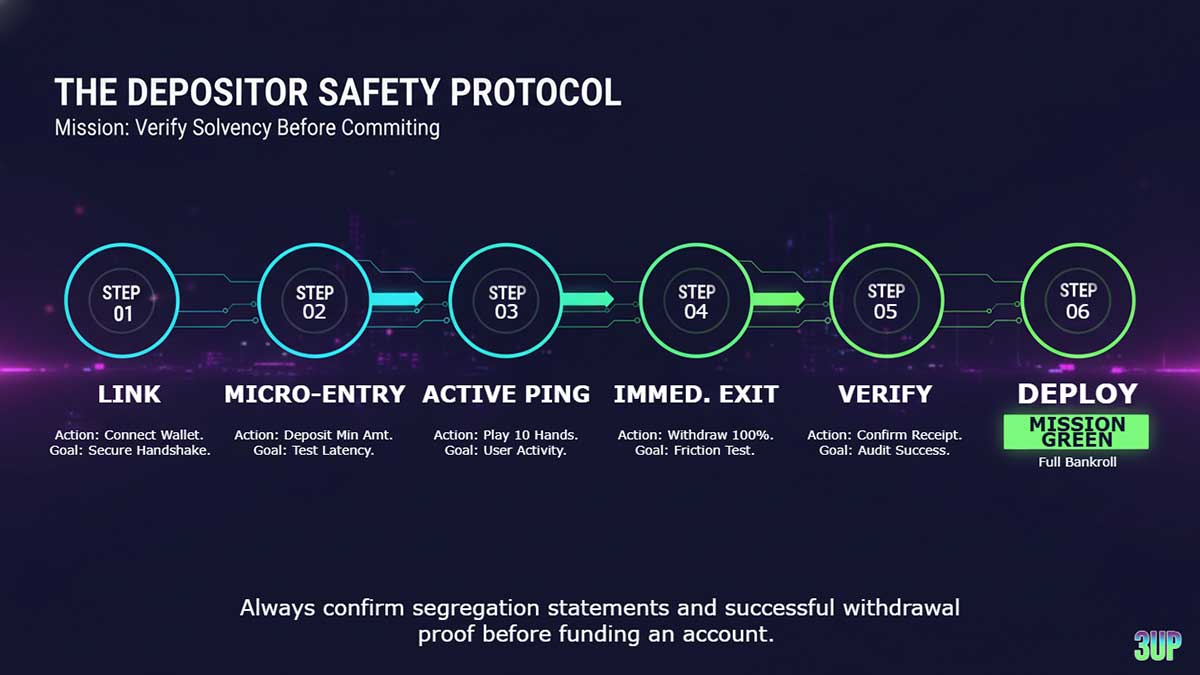
The problem of bank security is not related to the software brand. It is founded on jurisdiction and reserve requirements in licensing. Separating player funds legally should also be conducted. Do not deposit in case these factors are not clear. It is a significant distinction in safe online poker. Protection of the banking is performed outside of the game client.
In this case tension in the middle is solved. Liquidity keeps you informed on how the games are running. The money returns in the form of payments. This is the breakdown of most legacy-branded rooms; not deliberately, but on purpose. Online poker security wise, fund segregation is more important than UI or brand legacy.
Here’s the actual mechanism.
Reserve and segregation are some of the models to be followed by licensed operators in regulated jurisdictions. This means that balances of players are held separately of operating capital. They are also cushioned against insolvency events. This is normally obscured by unlicensed or not tightly regulated skins. This creates payout friction or silent freezes in the stress events.
Read this only in case you are going to deposit real money.
Playing real money Cryptologic poker magnifies every licensing and segregation failure. The issues with the payment and withdrawal modes arise during stressful times. At that stage, reliability is needed.
Run Your Own Poker Website Using White Label Solutions
The look of what security actually is.
Segregated player funds This is a type of account that is distinct but remains under the same legal entity as the operational accounts.
Transparency withdrawal history is the fact that one has been given what he/she deserves at the right time in a transparent way.
The majority of consumer protection laws have a deposit limit, a self-exclusion provision, and cooling-off of accounts as responsible gambling provisions.
Depositor-checklist-payout Test.
Before the material capital is invested:
- Deposit a small sum.
- Play but little.
- Get your money out as quick as you can.
- See how long it takes to pay out and how it is all done in the same way.
Premature testers of this test are able to avoid traps. They are aware of friction in cases when balances are extremely large. This eradicates failure because of late identification of problems.
Do not trust segregation declarations or good withdrawal evidence till money is put into an account. Minor deposits and withdrawals, each time.
Pros and cons: Is Cryptologic room deployment by serious players in 2026 justified?
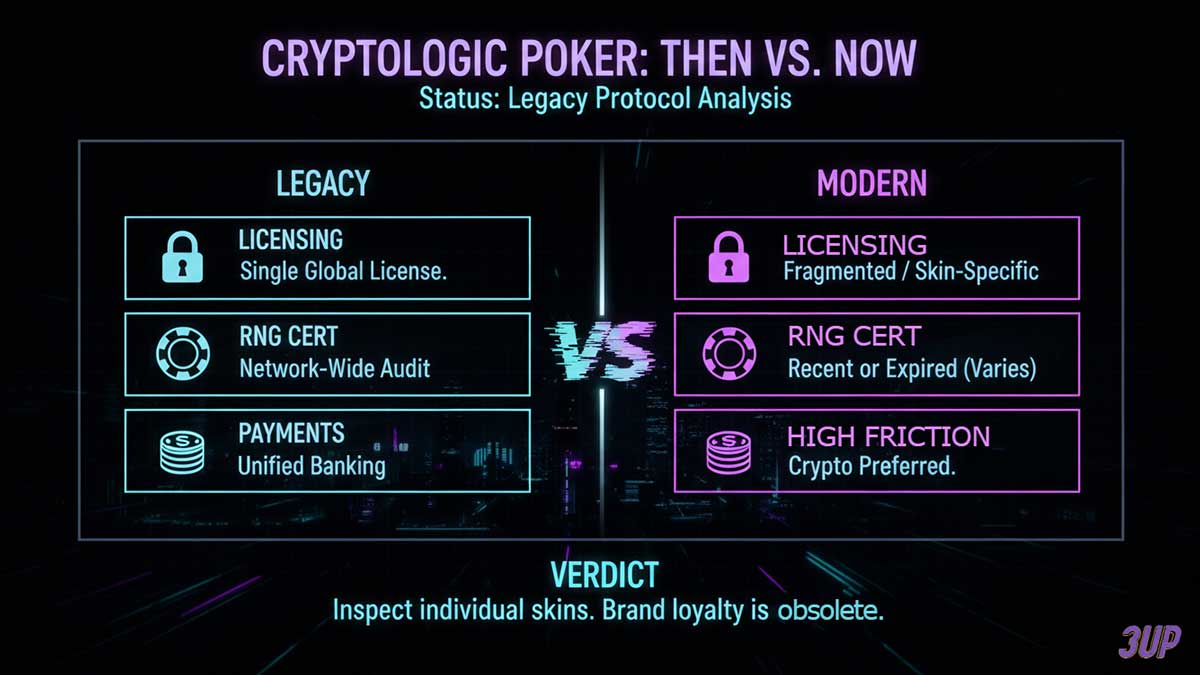
Where is Cryptologic poker safe to play now? There are real trade-offs of old fashioned charm and already established mechanics. Strict three-gate Go/No-Go or walk off. In 2026, when Cryptologic poker sites are considered, the element of nostalgia is less significant. This transforms to structural survivability and long term stability.
This is the river card. It is no more an emotional choice. Similar to the majority of the legacy poker software, Cryptologic was at its peak prior to the current compliance requirements.
Cryptologic poker remains as an old system that is swallowed into bigger portfolios. The infrastructure that has been left behind today is path-dependent infrastructure, which is stable at times, or quietly going away. The liquidity migration takes place following regulatory shocks. It is a process that is documented. This process is not inhibited by nostalgia.
The Three-Gate Go/No-Go Rule
Fail one gate → No-Go.
Cryptologic poker software itself is not unsafe. Nevertheless, it is no longer a living ecosystem. The capital and optionality were stored since a player made a decision to fold.
1. Player pathway
- House rules: Conservative bankroll.
- Do not play high stakes tables which are not liquid.
- Rebel, through the gates, quarterly.
2. Operator pathway
- Automate certification of RNG.
- Publish issue reserve reports and segregation reports.
- Openness on the implementation of AI and RTA.
- Sunsetting with no transparency can only erode the trust you build.
The three rules of the gate turns the uncertainty into a reasonable decision. Punishment overcomes nostalgia at confrontation. Capital and optionality were saved by the fold that was made by the player.
Before you make a deposit, run the three gates. Most legacy networks do not have the ability to ensure long-term liquidity, unlike modern professional poker sites. This danger multiplies rapidly in high stakes online poker. Under thin liquidity, liquidity is typically distorted. 3UP Gaming provides updated checklists and regulatory clarifications.
It also offers integrity structures to guide players and operators. These tools are employed in ensuring that there are no hype or short cuts to defensible decisions. Register to be alerted in case of a change of conditions.
Key Takeaways
- Software heritage does not offer safety.
- Licensing and segregation determine the protection of depositors.
- Liquidity failure is predictable, and avoidable.
- To serious poker players, uncertainty is an expense, prior to variance.
- The three-gate rule avoids most of the losses.
- Before scaling off deposits, the withdrawal is to be tested.
You are not to deposit because you cannot check the safety within five minutes.
Further Reading

These checks are the same ones used to evaluate trusted poker sites. They can be used both on new and old platforms. The process covers core poker site trust factors. These are the assessments made by the regulators and professionals.
- Search the license inside the regulator registry.
- Testing and Certifying of the RNG.(eCOGRA or equivalent).
- Lobby observation or tracking solutions.
- Testing of small amounts withdrawals.
- Had issued a statement of segregation.
Further Reading (internal)
- Online poker licensing and reserve.
- Testing and Certifying of the RNG.
- Poker liquidity and traffic analysis.
Glossary
- RNG:Random Number Generator that determines the outcome of cards.
- eCOGRA: It is a testing agency that is independent, and it certifies fairness of RNG.
- Liquidity: Games have active volumes of players.
- Segregation: The separation of the operating capital and the player funds.
- Skin: Operator front-end common software.
- Sunsetting: A slow shift to old platforms.
FAQ: Play Cryptologic Poker
How do I go about the safety of legacy poker platforms in the near future?
- Position check license, RNG licensure and perform small withdrawal test. Ignore branding claims. Another period of regulation was when the first Cryptologic gaming system was designed.
What are the ways that RNG certifications authenticate themselves before a vendor is chosen?
- Search available audit reports eCOGRA or otherwise. Ensure that they are open to the world. Make sure that such reports are attached to the running system.
How should the operators treat AI bots and RTA?
- Introduce detection systems, trace records and impose fines in proportion without revealing the exploitation vectors. This is the same standard applied to all major poker software providers. They are subjected without consideration of their reputation.
How do you define bot detection and bans to players in a manner that will be safe?
- Policy, rather than procedure, exposure. Be mindful of the outcomes of equity and attractiveness.
How safe is real-money Cryptologic poker today?
- The software name does not matter concerning the aspect of safety, which is pegged on licensing, certification, liquidity, and banking protection.
How would crypto poker rooms determine the alignment of MiCA or FCA?
- Licence custody rules in the current regulatory framework. Ensure that there is adherence to AML/KYC. Ensure that the funds of the players are segregated properly.
What will occur in case one of the sites of the partners is unsustainable in terms of liquidity?
- Sunset the integration. The decline in liquidity is structural and is rarely reversible.
How should the AI and RTA policies be revealed?
- Publish enforcement policies, protection of players and tracks of escalation; where the